 Best Online Therapy
Hey there — this article focuses on how to overcome phobias. If a phobia is making your world feel smaller, you’re not alone, and you’re definitely not broken. Maybe it’s heights that stop you from doing that mountain walk with friends, spiders that send you running from a room, flying that keeps you from holidays, or something else entirely. That sudden rush of panic, the racing heart, the urge to avoid it at all costs — it can feel completely out of your control.
As a Chartered Psychologist registered with the British Psychological Society (BPS), I often work with people who are ready to learn how to overcome phobias and regain their freedom.
The really encouraging part?
Phobias are one of the most treatable anxiety issues we see. With practical steps you can start today and, when needed, professional support from BPS-registered experts, most people make real, lasting progress.
Let’s walk through this together — no rush, no pressure, just clear, kind guidance.
What Exactly Is a Phobia (and Why Does It Feel So Powerful)?
A phobia isn’t just ordinary fear. It’s an intense, irrational response that triggers your body’s full alarm system — pounding heart, sweating, dizziness, even a sense of impending doom. Unlike everyday caution, phobias often lead to avoidance, which accidentally makes the fear stronger over time.
In the UK, phobias affect millions — they’re among the most common anxiety-related challenges (NHS England Digital, 2025; Mind, 2023). They can start from a single scary moment, something learned in childhood, or even a genetic predisposition. The important thing to know: this isn’t a personal failing. It’s a brain pattern — and brains can change. Understanding this is often the first gentle step in overcoming phobias.
Step 1: Self-Help Tools to Start Overcoming Phobias at Home
You don’t have to wait for professional help to begin. Many people start by overcoming phobias with small, manageable steps that build real confidence.
- Get to know your fear — Reading trustworthy sources like the NHS phobias page or Anxiety UK guides helps take the mystery (and power) away. When you realise the fear is a learned reaction rather than a real threat, it already feels less overwhelming.
- Calm your body first — Simple techniques like 4-7-8 breathing (inhale 4 seconds, hold 7, exhale 8) or progressive muscle relaxation can lower the physical panic when you’re facing a mild version of the trigger.
- Create your own fear ladder — This is one of the most effective ways to start overcoming your phobia. List steps from easiest to hardest (e.g., for a dog phobia: look at pictures → watch videos → see a dog from across the street → stand near one → touch one). Stay with each step until your anxiety drops by about half — your brain learns it’s safe.
- Gently question the thoughts — Ask yourself things like: “What’s the actual evidence this will happen?” or “What’s the worst, best, and most likely outcome?” These CBT-inspired questions shrink the story of fear.
These tools work beautifully for milder phobias. But if avoidance is really limiting your life — work, relationships, travel — reaching out for help is a smart, compassionate move.
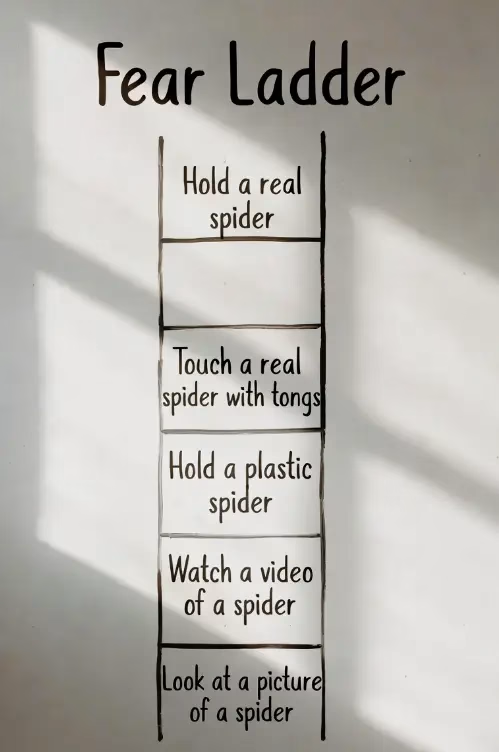
Fear Ladder to Help Overcome Phobia
A gentle, step-by-step exposure plan to help overcome a phobia of spiders (using only safe, non-poisonous examples). Start small, build confidence — progress at your own pace.”
Step 2: Professional Support – When and How to Get It in the UK
If self-help isn’t moving the needle enough, professional treatment is incredibly effective — often helping 70–90% of people see major relief. As a BPS-registered Chartered Psychologist, I use approaches backed by the BPS and NICE guidelines, and I see the transformation with clients.
The most proven method is exposure therapy (often combined with CBT). You face the fear gradually and safely — in real life, through imagery, or even virtual reality for things like flying. Over time, your brain re-learns that the situation isn’t dangerous, and the anxiety fades naturally.
In the UK, you have solid options:
- NHS Talking Therapies — Free, with self-referral or via your GP. They provide CBT and exposure (usually 6–12 sessions). Wait times vary, but many areas offer online access.
- Private support — For quicker access, BPS-registered Chartered Psychologists or BACP/UKCP therapists are excellent. Sessions typically £80–£120; video/online makes it easy from anywhere in the UK.
- Immediate support — Helplines like Anxiety UK (03444 775 774) or Mind (0300 123 3393) for advice and signposting.
A lot of people start with a free 15-minute discovery call — a gentle, no-pressure way to see if we feel like a good fit.
Step 3: Staying Free – Long-Term Strategies for Overcoming Phobias
Once the phobia loses its grip, the goal is to keep it that way:
- Practice occasional “booster” exposure so the fear doesn’t creep back.
- Connect with others — Anxiety UK groups or Triumph Over Phobia UK forums offer community and shared tips.
- Keep a simple progress journal — note small wins (“Today I stayed calm near a photo for 15 minutes”) to build momentum.
- Support your overall wellbeing — Regular movement, good sleep, and cutting back on caffeine/alcohol all lower baseline anxiety.
Overcoming phobias isn’t about erasing fear forever — it’s about the fear no longer controlling your choices. With steady steps and the right support when needed, most people get there.
If this feels like the right moment to take the next step — whether you’re dealing with a specific phobia or just want to explore — I’m here. Book a free 15-minute discovery call today. No obligation, just a warm conversation to see how we might work together.
You’re already taking a brave step by reading this. You’ve got this.
References for How To Overcome Phobias
- British Psychological Society. (2022, November 17). I’m scared….get me out of here! The psychology of fears and phobias. https://www.bps.org.uk/blog/im-scaredget-me-out-here-psychology-fears-and-phobias
- British Psychological Society. (2015, February 16). Helping triumph over phobia. https://www.bps.org.uk/psychologist/helping-triumph-over-phobia
- Kodzaga, I., et al. (2024). Unconscious exposure therapy for phobias: A meta-analysis. Psychological Bulletin. https://doi.org/10.1037/bul0000437
- Mind. (2023). Phobias. https://www.mind.org.uk/information-support/types-of-mental-health-problems/phobias/
- National Health Service. (2022). Phobias – Treatment. https://www.nhs.uk/mental-health/conditions/phobias/treatment/
- National Health Service. (2022). Phobias – Self-help. https://www.nhs.uk/mental-health/conditions/phobias/self-help/
- NHS England Digital. (2025). Adult Psychiatric Morbidity Survey: Survey of Mental Health and Wellbeing, England, 2023-24. https://digital.nhs.uk/data-and-information/publications/statistical/adult-psychiatric-morbidity-survey/survey-of-mental-health-and-wellbeing-england-2023-24
Article by Anna Keyter
Related Posts

Christmas Depression Counselling: Addressing Loneliness and Depression During Holidays
As the holiday season approaches, many individuals may experience heightened...
Emergency Numbers UK: 999, 112 & 24/7 Crisis Helplines
Emergency Numbers UK – Quick Guide to Help When You Need It. In a crisis, knowing...